
There are victories that add another line to a fighter’s record, and then there are victories that alter the historical record of an entire sport.
Islam Makhachev’s victory over Ian Machado Garry at UFC 330 belongs firmly in the second category.
On a memorable night in Philadelphia, Makhachev successfully defended the UFC welterweight championship, defeated one of the division’s most technically accomplished challengers and, perhaps most importantly, established a new benchmark for sustained excellence inside the Octagon.
The Russian champion entered the Xfinity Mobile Arena knowing exactly what was at stake. He was already tied with Anderson Silva on 16 consecutive UFC victories. One more win would take him alone to the top of the list.
He delivered.
After 25 minutes of wrestling, striking, positional battles and increasingly desperate resistance from Garry, Makhachev was awarded a unanimous decision by scores of 49-46, 49-46 and 48-47. The result moved his professional record to 29-1 and his UFC winning streak to an extraordinary 17 fights.
The numbers are remarkable. The story behind them is even more impressive.
A historic night in Philadelphia
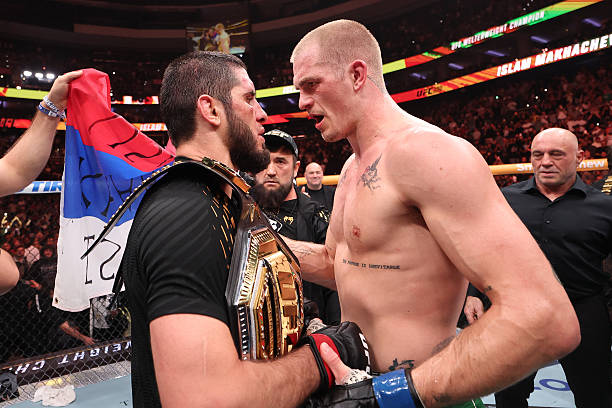
UFC 330 represented a major occasion for Philadelphia, but the significance of the main event extended far beyond the city.
Makhachev was not simply defending his welterweight championship. He was fighting for a place in UFC history.
Anderson Silva’s 16-fight winning streak had stood as one of the promotion’s most enduring statistical landmarks. Silva’s run was synonymous with his astonishing reign as middleweight champion, during which he seemed capable of finding a spectacular solution to almost any problem placed in front of him.
Makhachev’s challenge was different.
He was not attempting to emulate Silva’s style or replicate his reign. Instead, he had built an entirely different form of dominance, one based upon suffocating wrestling, positional intelligence, physical strength, composure and an almost extraordinary ability to dictate where a fight takes place.
Against Garry, all of those qualities were required.
The Irishman entered the bout with significant physical advantages and a reputation for being one of the division’s most difficult long-range strikers. Makhachev, despite being the smaller man in terms of natural frame, had already demonstrated that moving up to welterweight had done nothing to diminish his effectiveness.
He had made that abundantly clear at UFC 322.
From lightweight king to two-division champion
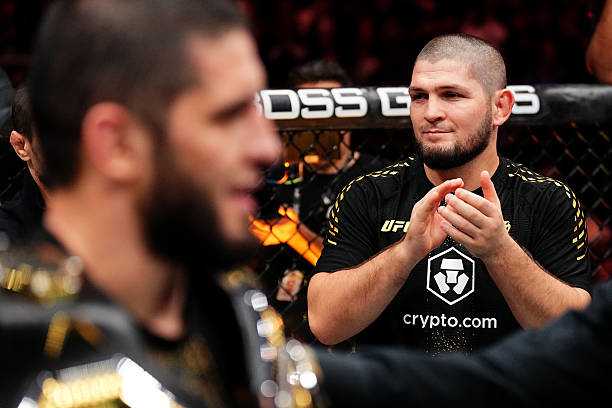
Before discussing what happened against Garry, it is essential to understand how extraordinary Makhachev’s career trajectory has been.
For years, Makhachev was regarded as the heir to the Dagestani wrestling dynasty established by his close friend and former training partner Khabib Nurmagomedov.
That comparison was understandable, but it also threatened to obscure Makhachev’s individuality.
He had been coached by Khabib’s father, the legendary Abdulmanap Nurmagomedov, and developed within the same extraordinary combat-sports culture that produced so many elite fighters from Dagestan. The influence of sambo, wrestling and relentless positional control became obvious very early in his career.
But Makhachev gradually developed into something more than simply “the next Khabib”.
His striking became sharper. His kicking game became increasingly dangerous. His submission repertoire expanded. His ability to switch between striking and wrestling became more sophisticated.
Most importantly, he developed the patience to let fights unfold according to his preferred rhythm.
His first UFC defeat came against Adriano Martins in 2015, when Makhachev was stopped by knockout in the first round. It remains the only defeat on his professional record.
Since September 2016, however, defeat has become almost completely alien to him.
His historic streak began with a decision victory over Chris Wade. It continued through victories over Nik Lentz, Gleison Tibau, Kajan Johnson, Arman Tsarukyan, Davi Ramos, Drew Dober, Thiago Moisés, Dan Hooker and Bobby Green before reaching the championship level.
Then came the defining chapter.
Charles Oliveira and the arrival of a champion
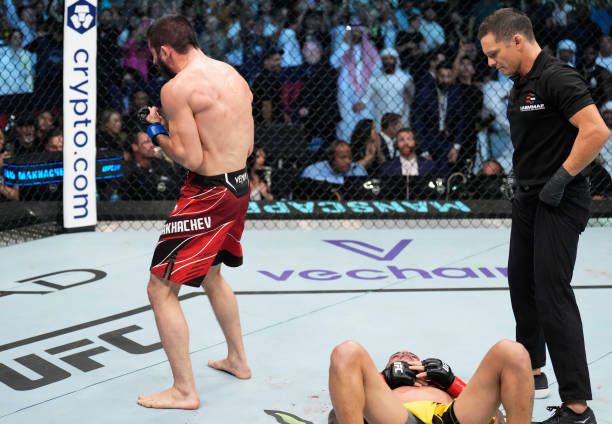
At UFC 280 in October 2022, Makhachev finally got his opportunity to fight for undisputed lightweight gold.
Standing opposite him was Charles Oliveira, one of the most dangerous submission artists in UFC history.
Oliveira had won 11 consecutive fights. He had established himself as a terrifying finisher and had developed a reputation for surviving chaotic situations that would have broken lesser fighters.
Makhachev dismantled him.
The Russian submitted Oliveira via arm-triangle choke in the second round, capturing the vacant UFC lightweight championship and announcing that the Dagestani era would continue under a new leader.
It was not simply a title victory.
It was a statement that Makhachev could take down an elite opponent, impose his grappling game and finish a fighter who had made an entire career out of being exceptionally difficult to submit.
And then came Alexander Volkanovski.
The Volkanovski Rivalry
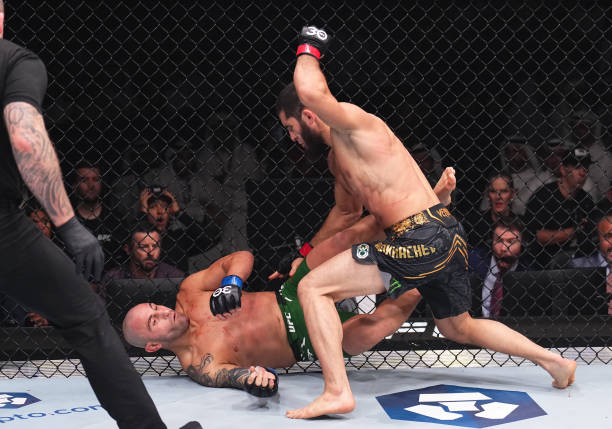
If Oliveira established Makhachev as champion, Alexander Volkanovski helped establish him as one of the very best fighters on the planet.
Volkanovski was the featherweight champion, a pound-for-pound superstar and one of the most technically complete fighters in MMA.
Their first encounter at UFC 284 in February 2023 was one of the most important fights of Makhachev’s career.
It went five rounds.
Volkanovski’s movement, balance and ability to remain competitive in grappling exchanges presented Makhachev with problems that few previous opponents had been able to create.
Makhachev nevertheless emerged victorious by unanimous decision and retained his lightweight title.
The rematch was dramatically different.
At UFC 294, Makhachev stopped Volkanovski with a head kick in the first round.
That victory was particularly significant because it demonstrated how much Makhachev’s striking had evolved. He was no longer simply a wrestler looking to drag an opponent into deep water.
He could hurt world-class opponents on the feet, too.
The Dustin Poirier Test

Makhachev’s next major challenge came against Dustin Poirier at UFC 302.
Poirier was one of the great veterans of his generation, a ferocious boxer with tremendous power, resilience and experience in championship fights.
For much of the bout, Poirier demonstrated why he had been so difficult for so many opponents to deal with.
Makhachev eventually found the finish.
With only 2:42 remaining in the fifth round, he submitted Poirier with a D’Arce choke, successfully retaining his lightweight championship.
That victory was another demonstration of Makhachev’s remarkable versatility. He could win decisions, dominate through wrestling or knock opponents out, and, the cherry on top, he could find submissions deep into five-round championship fights.
Renato Moicano and The Final Lightweight Chapter
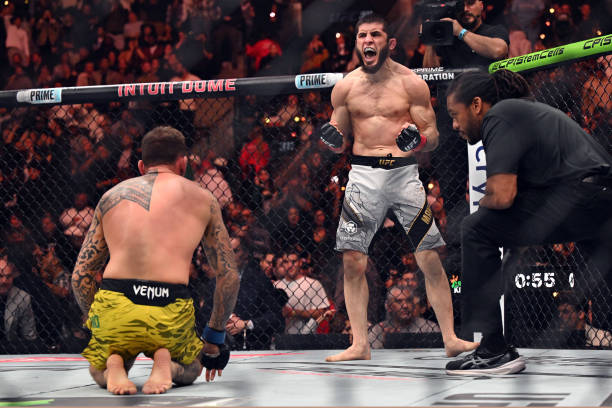
Makhachev’s final lightweight title defence came against Renato Moicano at UFC 311 in January 2025.
Once again, there was no prolonged drama.
Makhachev submitted Moicano with a D’Arce choke at 4:05 of the opening round. It was his fifth victory in a UFC lightweight title fight and another finish on a résumé already packed with them.
He subsequently vacated the lightweight championship. That decision was not the result of defeat. It was the beginning of the next challenge.
Makhachev wanted to move up.
The Leap to Welterweight
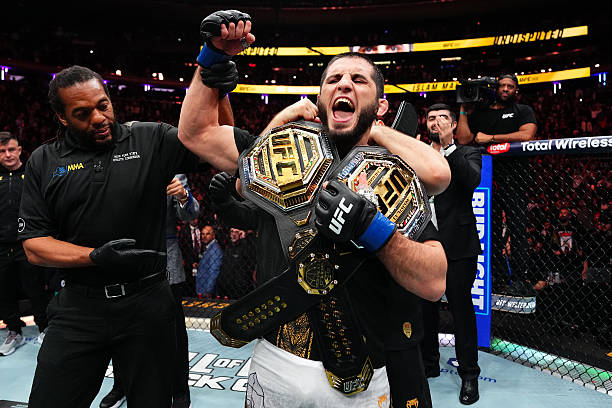
Moving from lightweight to welterweight is not simply a matter of adding weight to the scales. The opponents are larger, stronger, and the ability to absorb punishment can be different.
The physical consequences of wrestling with a 170-pound elite fighter for 25 minutes are significant. Yet Makhachev had already spent years demonstrating that his technique could neutralise physical advantages.
At UFC 322 in November 2025, he received his opportunity to prove it. Jack Della Maddalena was the reigning welterweight champion after defeating Belal Muhammad at UFC 315
Makhachev dominated him. The judges scored every round 50-45, and Makhachev became only the 11th fighter in UFC history to win championships in two weight classes. The statistics told the story. Makhachev controlled Della Maddalena for 19 minutes and 10 seconds and completed all four of his takedown attempts.
The victory also gave Makhachev his 16th consecutive UFC win. At that moment, he had equalled Anderson Silva. One fight later, the record belonged to him.
UFC 330: Makhachev vs Garry
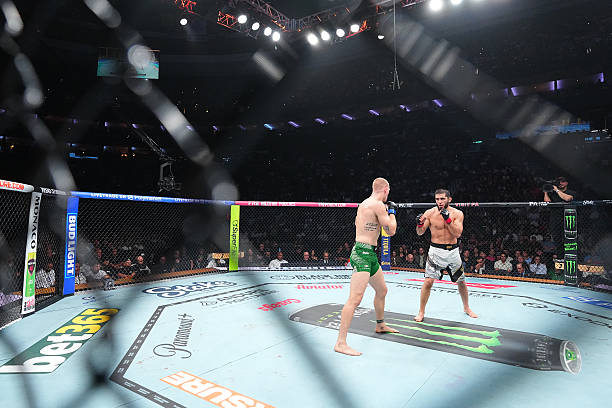
And so we arrived at Philadelphia.
Ian Machado Garry represented an entirely different challenge.
Garry is tall, rangy and comfortable fighting at long range. He possesses the kind of striking game designed to frustrate wrestlers: movement, distance management, kicks and an ability to operate from positions where conventional takedown entries become difficult.
The physical disparity was obvious. Makhachev had moved up from lightweight, and Garry was a natural welterweight with considerable height and reach.
That made Makhachev’s tactical approach particularly fascinating. He did not attempt to turn the fight into a kickboxing contest. Why would he? Makhachev has spent his career developing one of the most sophisticated grappling systems in MMA. The objective was simply to make Garry fight the fight he wanted.
Round one: Establishing Control
From the opening exchanges, Makhachev attempted to close the distance and bring his wrestling into play.
Garry’s length gave him opportunities to score from the outside, but Makhachev continually threatened the space between them. This is one of the defining characteristics of his style. The takedown itself is only part of the equation. The threat of the takedown changes the opponent’s striking.
A fighter who has to constantly think about being taken down cannot always commit fully to combinations.
A fighter who cannot freely plant their feet cannot always generate maximum power.
And a fighter who is worried about the next wrestling exchange can find their entire offensive rhythm disrupted. Makhachev has become exceptionally good at creating that psychological pressure.
Round two: The Moment That Changed The Fight
The second round produced the most spectacular moment of the contest.
Makhachev landed a stunning head kick that dropped Garry.
For a brief moment, it looked as though the historic night might end in a spectacular finish rather than a decision.
Garry, however, demonstrated precisely why he had earned the title opportunity.
He survived, recovered and continued fighting.
The knockdown was nevertheless enormously important. It showed that Makhachev’s striking could not simply be dismissed as an accessory to his wrestling. When Garry had to worry about takedowns and grappling, the Russian could also exploit openings upstairs.
The head kick became one of the defining images of UFC 330.
Garry Fights Back
The fight was not a one-sided procession. That is important.
Makhachev’s victory was dominant enough to be unanimous, but Garry repeatedly demonstrated why he was considered a legitimate championship challenger.
The Irishman defended takedowns at important moments, landed effective kicks and found periods of success as the fight progressed.
The third and fourth rounds in particular provided Garry with opportunities to make the contest competitive. Reuters noted that Garry showed resilience and had success with his kicking game, particularly as the fight developed. That resistance made Makhachev’s performance more impressive rather than less, forcing the champion to adapt.
He could not simply walk through Garry. He had to manage the distance, conserve energy, return to wrestling and prevent Garry from establishing a sustained striking rhythm.
That is what elite championship fighters do.
The Championship Rounds
The fifth round demonstrated another of Makhachev’s great qualities: composure.
There was no desperation. No unnecessary brawl or reckless attempt to force a finish merely because the fight was approaching its conclusion. Makhachev stayed disciplined.
He continued to wrestle, control positions and prevent Garry from producing the kind of late surge that could have dramatically changed the judges’ perception. When the final horn sounded, there was little doubt about the winner. The official scores were 49-46, 49-46 and 48-47 in Makhachev’s favour.
It was not his most spectacular victory. In historical terms, however, it may be one of his most important.
Seventeen Consecutive UFC Victories
The significance of the number 17 cannot be overstated. Makhachev’s streak began in 2016.
It has survived changes in weight class, different generations of contenders, championship pressure, five-round wars and opponents with radically different styles.
And now it has surpassed the great Anderson Silva.
Silva’s 16-fight run remains one of the most extraordinary periods in UFC history. During his peak, the Brazilian combined precision striking, creativity, timing and psychological warfare to become one of the sport’s defining superstars.
Makhachev has now taken the statistical record that once belonged to Silva alone. He has done so without relying upon one single method, which might be the most remarkable part.
The Evolution of Makhachev
When Makhachev first entered the UFC, the perception was straightforward. He was a highly accomplished sambo fighter with exceptional wrestling. Today, that description feels hopelessly incomplete.
Makhachev is a complete mixed martial artist. His grappling remains the foundation, but his striking has developed into a genuine weapon that will now stifle the best strikers in the MMA world.
His kicking game has become increasingly dangerous. His submissions are varied. His positional control is extraordinary, and the ability to conserve energy across five rounds is elite.
And with all of those incredible assets, his fight IQ may be his greatest weapon of all.
Five knockout victories, 13 submissions and 11 first-round finishes illustrate how frequently Makhachev has been able to finish fights rather than merely win them on the scorecards.
That is an important distinction. A dominant decision fighter is impressive. A fighter capable of dominating through multiple forms of attack is something else entirely.
Why the Dagestani System Matters
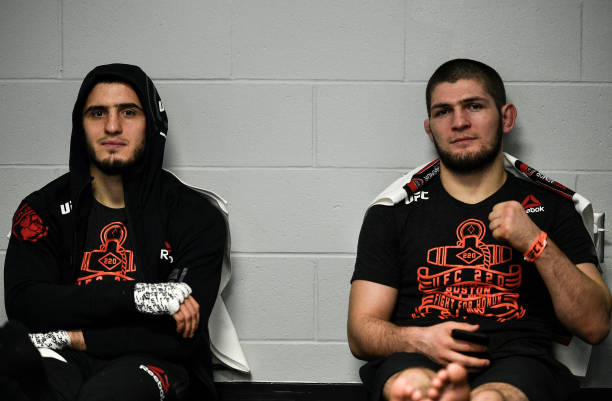
Makhachev’s career cannot be discussed without acknowledging Abdulmanap Nurmagomedov. The late coach created a system built around wrestling, sambo, positional control and relentless conditioning.
Khabib Nurmagomedov became its most famous product. Makhachev became its most complete.
But the system did not simply teach fighters how to take opponents down. It taught them how to think. The fundamental philosophy is based on forcing opponents to constantly solve problems. If they defend the takedown, they expose themselves to strikes.
If they concentrate on strikes, they can be taken down.
If they defend the first takedown, another chain begins.
If they reach the fence, they can be controlled there.
If they turn away, their back becomes available.
Makhachev has elevated that concept to an extraordinary level, as his opponents are rarely dealing with one attack; they are dealing with a chain of attacks that are always three steps ahead of the opposition.
The Difference Between Makhachev and Khabib
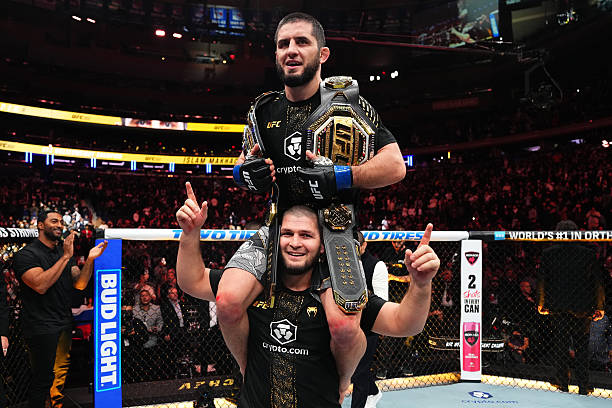
It is tempting to compare Makhachev constantly with Khabib Nurmagomedov.
They trained together. They share the same roots. They employ similar wrestling principles. However, their careers have been different.
Khabib retired undefeated with a 29-0 professional record and became one of the most dominant champions MMA had ever seen.
Islam has suffered one defeat, but his career has lasted longer and has increasingly demonstrated a broader technical range and fought a greater level of opposition.
Islam has developed a striking game that is more varied than Khabib’s. His kicking has become a significant part of his offensive arsenal, and his recent move to welterweight has added another dimension to his legacy.
He is no longer simply carrying forward the Dagestani tradition. He is adding to it at a frightening pace and at what could be seen as an unmatched level.
The Two-Division Achievement
Winning UFC championships in two divisions is an extraordinarily difficult accomplishment.
Makhachev joined an elite group when he defeated Della Maddalena at UFC 322.
The UFC recognised him as the 11th fighter in promotion history to hold championship gold in two weight classes.
What makes his accomplishment particularly impressive is the manner in which he did it. He did not move up for a one-off superfight. He moved up and immediately became champion.
Then, at UFC 330, he defended the belt.
Winning a second championship can sometimes be regarded as a remarkable achievement in itself. Defending it against another elite contender demonstrates that the fighter genuinely belongs in the new division. Islam Makhachev has now done both.
The 29-1 record
The record itself is astonishing.
Twenty-nine victories.
One defeat.
And that lone defeat came more than a decade ago in the UFC.
Since then, Makhachev has transformed himself from a promising prospect into a champion, from champion into a dominant champion, from dominant champion into a two-division champion and now from two-division champion into the holder of the longest winning streak in UFC history.
The remarkable thing is not simply the quantity of victories; it is the quality.
Arman Tsarukyan.
Dan Hooker.
Charles Oliveira.
Alexander Volkanovski, twice.
Dustin Poirier.
Renato Moicano.
Jack Della Maddalena.
And now Ian Machado Garry.
These are not names from a carefully curated schedule designed to inflate a record.
They are elite-level fighters who represented fundamentally different challenges, to which Islam Makhachev kept finding answers time after time.
The Significance of Ian Machado Garry
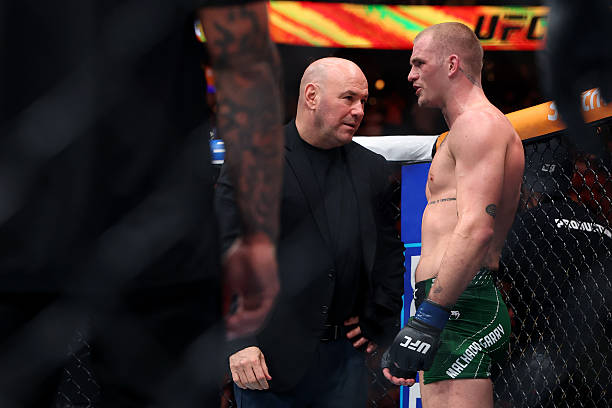
It would be unfair to portray Garry merely as the opponent who happened to be standing opposite Makhachev when history was made.
He deserves considerable credit. He entered the fight with an ambitious game plan and showed genuine resistance to one of the greatest wrestlers in MMA. He survived a damaging second-round knockdown, defended takedowns, and created problems with his length. The Irishman had moments in the middle rounds and remained competitive until the final bell.
Afterwards, Garry acknowledged Makhachev’s achievement and expressed his determination to return, which feels like almost a certainty. This is important because the best champions are often defined by the quality of the opposition they overcome.
Makhachev needed Garry to be good.
Garry was.
Makhachev was simply better.
A different kind of greatness
MMA greatness is difficult to measure.
Is it championship reign?
Is it undefeated records?
Is it the quality of opponents?
Is it longevity?
Is it spectacular finishes?
Is it dominance?
There are so many questions and factors that Islam increasingly has an argument in almost every category, fight by fight.
He has held championships in two divisions.
He has defeated some of the greatest fighters of his generation.
He has finished elite opponents by submission and knockout.
He has won five-round decisions.
He has overcome high-level strikers, jiu-jitsu practitioners, wrestlers and fighters who are the whole package, and now he owns the UFC’s longest winning streak. That last achievement is particularly powerful because a winning streak measures consistency. One great performance can make a fighter famous. Two or three can make them a champion.
Seventeen consecutive UFC victories suggest sustained excellence, which only the likes of Jon Jones and Georges St-Pierre can claim to.
Anderson Silva’s Record was Never Supposed to be Easy to Break

There is also something poetic about the way Makhachev broke Silva’s record. Silva’s 16-fight streak lasted from 2006 to 2013 and became synonymous with one of the most spectacular championship runs in MMA history. For years, it looked almost untouchable. Makhachev first reached Silva’s number at UFC 322.
Then came Philadelphia.
One final victory.
One final test.
And now the record reads:
Islam Makhachev — 17 consecutive UFC victories.
Silva’s record has not been diminished. If anything, Makhachev’s achievement reinforces just how extraordinary Silva’s original run was. Records are most meaningful when they survive for a long time, and at the end of the day, they’re meant to be broken.
What’s Next?
The obvious question is whether Makhachev can extend the streak even further.
Seventeen is now history. Eighteen would move him further into uncharted territory. Twenty would sound almost absurd.
But that is precisely what makes Makhachev’s current career so fascinating. The welterweight division is full of dangerous contenders, like Michael Morales and Carlos Prates; fighting at 170 pounds introduces physical challenges that were less pronounced at lightweight.
Makhachev has already proved he can win the belt. He has now proved he can defend it. The next phase of his career will determine how high his legacy ultimately rises.
If he remains at welterweight and continues defeating elite challengers, the argument surrounding his place among the greatest UFC fighters of all time will become increasingly difficult to resist.
The Legacy Question
There will always be debates about the greatest fighter in UFC history.
Jones, GSP, Silva, Demetrious Johnson and Khabib will all have a seat in the conversation, but now it’s fair to say that Makhachev has earned a seat at that table.


Leave a comment