
Ten years on from UFC 200, the promotion once again finds itself leaning on spectacle, nostalgia and high-stakes matchmaking as it heads into UFC 329 at the T-Mobile Arena in Las Vegas.
Headlined by the long-awaited rematch between Conor McGregor and Max Holloway, the card sits at the intersection of eras. McGregor returns after a lengthy five-year layoff to reassert relevance in the welterweight division. At the same time, Holloway enters with momentum, durability, and arguably the most consistent body of work of any active featherweight-turned-lightweight contender in the sport.
But beneath the main event, UFC 329 is far from a one-fight show. It is a deeply layered card featuring rising prospects, former champions attempting reinvention, and stylistic clashes that feel carefully selected for entertainment value.
Conor McGregor vs Max Holloway II (Welterweight)

Their first meeting in 2013 feels like a different lifetime in MMA terms. McGregor won that bout by decision, but both fighters have evolved beyond recognition since then.
McGregor enters this fight as a largely unknown quantity. The questions are not about skillset; his left hand, timing and counter-striking remain historically elite, but about rhythm, durability, and whether extended inactivity has dulled his reflex-based style. At welterweight, his power carries naturally, but so too does the burden of facing larger, pressure-heavy opponents without recent cage time.
Holloway, by contrast, arrives as a volume machine refined to perfection. His boxing output, cardio and ability to absorb and return damage have made him one of the most reliable fighters in modern MMA. The key question for him is whether he can avoid early concussive danger, something McGregor has always specialised in creating.
The fight likely hinges on the opening rounds. If McGregor can land clean early counters, he remains one of the few fighters capable of shutting lights out instantly. If Holloway drags him into the later rounds, the pace and accumulation almost certainly tilt the fight in his favour.
This is not just a rematch; it is a collision between timing-based precision and volume-based attrition.
Prediction: Max Holloway via TKO round 2)
McGregor’s early threat is real, but Holloway’s pace is likely to accumulate damage as reactions slow.
Benoît Saint Denis vs Paddy Pimblett (Lightweight)
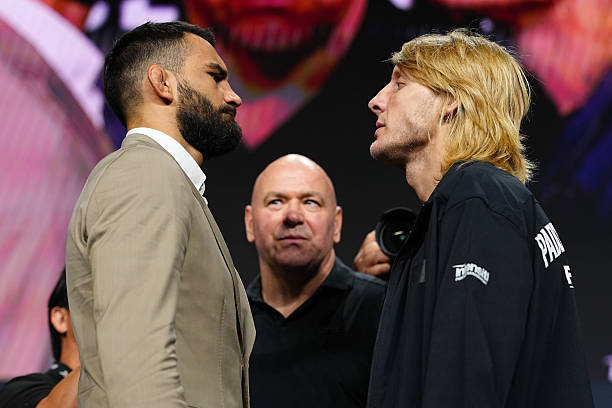
This is one of the most stylistically intriguing fights on the card.
Benoît Saint Denis brings forward relentless pressure, elite grappling transitions and a willingness to engage in physically taxing exchanges. His approach is simple but brutally effective: break opponents through pace and control.
Paddy Pimblett, however, enters with a very different rhythm. Unorthodox movement, creative striking entries, and opportunistic grappling scrambles define his style. While questions remain about his defensive grappling against elite pressure fighters, his finishing instincts cannot be ignored.
The fight essentially comes down to whether Pimblett can maintain distance and avoid being trapped against the fence or grounded for prolonged periods. If Saint Denis establishes control early, the momentum could become overwhelming. If Pimblett finds space, the scrappy nature of exchanges could favour his unpredictability.
This is a classic UFC matchmaking contrast: structured pressure versus chaotic creativity.
Prediction: Benoît Saint Denis via unanimous decision
Pimblett likely has moments, but Saint Denis’ control phases should dominate total minutes.
Cory Sandhagen vs Mario Bautista II (Bantamweight)
We have another rematch on this card, too. Mario Bautista looks to get revenge on the man who took his 0 back in 2019 in a Bantamweight title eliminator.
Sandhagen’s value lies in distance control and tempo disruption. He rarely allows opponents to fight at their preferred rhythm.
Bautista is efficient rather than explosive. His success depends on compressing space and turning the bout into a closer-range contest.
Cory Sandhagen remains one of the most technically fluid strikers in the bantamweight division. His length, movement and striking variety make him difficult to prepare for, even for elite opponents. However, he has often found himself in close fights where output and control become deciding factors.
Mario Bautista enters this bout on the strength of steady improvement and composure. His game is built on clean boxing fundamentals, disciplined footwork, and well-timed wrestling integration.
The key tactical battle here is range control. Sandhagen thrives at mid-to-long distance, while Bautista will look to close space and disrupt rhythm through pressure and clinch work.
If Bautista can turn this into a physical, grinding contest, he has a live chance. If Sandhagen dictates range, this could become a technical showcase.
Prediction: Cory Sandhagen via decision
Higher-volume striking at range should be decisive over 15 minutes, even if Bautista has brief wrestling success.
Brandon Royval vs Lone’er Kavanagh (Flyweight)
This is a pure stylistic wildcard.
Brandon Royval is one of the most chaotic fighters in the UFC unorthodox movement, with scrambling, grappling exchanges, and an almost reckless willingness to engage, making him dangerous at all times, but also vulnerable.
Lone’er Kavanagh represents the newer breed of flyweight: composed, athletic, and increasingly well-rounded. His ability to maintain structure in unpredictable fights will be tested severely here.
Flyweight fights often become attritional puzzles, and this one is no exception. Royval’s chaos versus Kavanagh’s control will determine whether this becomes a scramble-heavy war or a disciplined tactical win.
Prediction: Lone’er Kavanagh via decision
Cleaner positional control likely edges out Royval’s unpredictability over three rounds.
King Green vs Terrance McKinney (Lightweight)
This is a classic experience-versus-explosiveness matchup.
King Green brings composure, defensive awareness, and veteran savvy. He is difficult to finish and thrives when opponents burn early energy.
Terrance McKinney, meanwhile, is one of the most explosive starters in the division. His early finishing rate makes him dangerous in the opening exchanges, but questions remain about his ability to maintain output over three rounds.
If McKinney gets an early opening, this fight may not last long. If Green survives the initial storm, the momentum could swing heavily in his favour as the fight progresses.
Prediction: King Green via second-round TKO
McKinney’s early surge likely creates openings, but Green’s durability and pacing should take over once the initial burst fades.
Robert Whittaker vs Nikita Krylov (Light Heavyweight)
One of the most intriguing stylistic shifts on the card.
Robert Whittaker’s move to light heavyweight adds a new dimension to his already elite skillset. His speed, boxing combinations and defensive awareness translate well, but the question is how his power and durability hold up against naturally larger opponents.
Nikita Krylov brings long-range striking, grappling versatility and a proven ability to finish fights in multiple ways. His experience at light heavyweight gives him a physical familiarity advantage.
This is a fascinating experiment in athletic translation. Whittaker’s speed versus Krylov’s size and finishing threat makes this one of the most unpredictable fights on the card.
Prediction: Robert Whittaker via split decision
Speed and cleaner entries likely edge it out, but the size differential keeps it competitive throughout.
Cody Garbrandt vs Adrian Yañez (Bantamweight)
Garbrandt remains one of the division’s more difficult fighters to evaluate. His athletic attributes and hand speed are still present, but his defensive liabilities have been repeatedly exposed in exchanges where he commits beyond his exit points.
Yañez is more structurally consistent. He operates behind compact boxing combinations, with a measured approach to exchanges and fewer defensive lapses when pressured.
The key dynamic is volatility versus stability. Garbrandt’s path is early momentum; Yañez’s is attritional accumulation as exchanges extend.
Prediction: Adrian Yañez via decision
Garbrandt’s early explosiveness is likely to create moments, but Yañez’s composure and volume should take over across three rounds.
Gable Steveson vs Marcos Rogério de Lima (Heavyweight – UFC Debut)
Steveson enters with an elite wrestling pedigree, but MMA translation is never linear. The key question is not whether he can wrestle — it is whether he can safely enter striking ranges without absorbing damage.
De Lima is experienced, powerful, and comfortable in short exchanges. His advantage lies in MMA-specific timing and familiarity under striking pressure.
Early rounds are likely to be cautious, with Steveson seeking controlled entries and top position, while de Lima looks to punish predictable level changes.
Prediction: Marcos Rogério de Lima via second-round TKO
Steveson’s wrestling may create early control, but striking inexperience at range could be decisive over time.
Tracy Cortez vs Wang Cong (Women’s Bantamweight)
Cortez operates with a fundamentally sound approach: pressure, clinch work, and positional control. She is rarely spectacular, but consistently effective in controlling fight geography.
Wang Cong is still relatively untested at UFC level but brings sharper striking mechanics and faster straight-line offence. The question is how she responds when forced into prolonged grappling exchanges.
This is a classic striker-versus-grappler structure, but with an additional layer of UFC-level adjustment required for Wang.
Prediction: Tracy Cortez via unanimous decision
Cortez’s control phases and cage work likely neutralise striking advantages over three rounds.
Luke Riley vs Kai Kamaka III (Featherweight)
Riley enters with momentum and finishing ability, but this is a meaningful step up in competition. Kamaka has faced higher-level opposition and is typically durable enough to extend fights into deeper waters.
Riley’s path is early success — sharp striking and aggressive entries before Kamaka can establish rhythm. Kamaka’s advantage is experience and the ability to weather early surges.
Prediction: Kai Kamaka III via decision
Riley may start fast, but Kamaka’s durability and experience should become increasingly relevant as the fight progresses.
Prelims – Key Fights and Quick Picks
Jack Shore vs Chris Gutiérrez (Bantamweight)
A technical striking matchup where Gutiérrez’s low kicks and distance management are likely to matter more over time.
Prediction: Chris Gutiérrez via decision
Molly McCann vs Ernesta Kareckaite (Women’s Flyweight)
McCann’s pressure remains her defining trait, but defensive vulnerabilities persist against cleaner strikers.
Prediction: Ernesta Kareckaite via decision
UFC 329 – Card-Wide Outlook
UFC 329 is not defined by a single stylistic theme. Instead, it is built on contrasts: elite pressure systems against athletic unpredictability, returning stars against momentum fighters, and debutants tested immediately at UFC pace.
McGregor vs Holloway II carries the commercial weight, but the most revealing fights may sit underneath it — particularly Pimblett vs Saint Denis and Whittaker’s move to light heavyweight.
Across the card, the consistent question is adaptation: who can impose their preferred rhythm when facing opponents actively designed to disrupt it?


Leave a comment