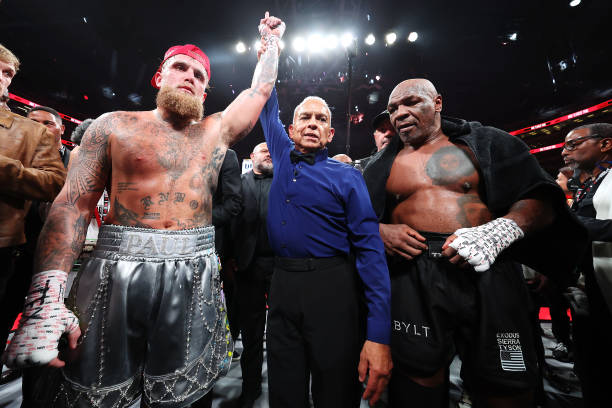
Boxing has always been a sport of spectacle as much as skill. From Muhammad Ali’s showmanship to the larger-than-life personas of fighters like Floyd Mayweather, the allure of boxing has often extended beyond the ring. But in recent years, events like Friday night’s atrocity of Mike Tyson vs Jake Paul have reignited the debate: Is boxing evolving into something greater, or are these spectacle-driven fights undermining its integrity?
I don’t think there’s anything for me to add on how the fight went. I think anyone with a logical thinking brain knew Paul would win against Mike Tyson, who is 58 years old, literally nearly died after having eight blood transfusions, losing half of his blood and 25 lbs in hospital fighting for his life in June.
However, let’s delve deeper into the implications of this fight and what it means for boxing’s future.
1. The Argument for Evolution
A Broader Audience
Celebrity-driven bouts have undeniably expanded boxing’s reach. Jake Paul’s transformation from YouTube star to professional boxer has brought millions of younger fans into the sport, many of whom might have never tuned in to a traditional boxing match. Events like Friday night’s fight with Mike Tyson and his fight with Tommy Fury amplify this trend, merging generations of fans and creating a shared spectacle.
These fights also blur the line between traditional sports and entertainment, making boxing more accessible to a casual audience. For better or worse, the sport is no longer confined to a hardcore fanbase. It’s a cultural phenomenon that thrives on social media engagement, pay-per-view sales, and viral moments.
Financial Benefits
Money, unfortunately, talks and fights like Tyson vs Paul generate serious revenue. These events attract sponsorship deals, sell-out arenas, and drive record-breaking pay-per-view numbers. The influx of cash doesn’t just benefit the fighters. It can trickle down to fund grassroots boxing programs, rejuvenate interest in the sport, and potentially create new opportunities for up-and-coming boxers, which, like it or not, is a win for the sport.
Rebranding Boxing as Entertainment
Boxing has historically struggled to compete with sports like football or basketball in terms of consistent mainstream appeal. By embracing its roots in spectacle, boxing has found a way to stand out. The narrative of Jake Paul, an influencer turned boxer who defeated a boxing legend, or 58-year-old Mike Tyson returning to defeat this entertainer who thinks he’s a boxer appeals to the world we live in now, a world driven by stories, personalities, and viral moments. It’s less about belts and rankings and more about creating unforgettable moments.
2. The Argument for a Step Back
Dilution of Sport Integrity
For combat sports purists, fights like Tyson vs Paul represent a step backwards, turning a respected sport into a carnival act. Traditional boxing is built on a foundation of rankings, championships, and elite competition. Critics argue that by prioritising spectacle over substance, boxing risks alienating its core audience and losing credibility.
How can boxing be taken seriously when a YouTuber with fewer than ten professional fights could face one of the greatest heavyweights of all time? This isn’t just an exhibition—it’s a clash of values. Tyson’s legacy was built through gruelling training, discipline, and competition. Allowing someone like Jake Paul to share the same stage can feel like a slap in the face to those who’ve dedicated their lives to the sport.
Risk of Overshadowing Real Talent
Fights like Tyson vs. Paul dominate headlines, leaving less room for rising stars and legitimate champions to shine. Boxers like Terence Crawford, Naoya Inoue, and Errol Spence Jr. are putting on masterclasses in the ring, yet they struggle to capture the mainstream attention that a novelty fight generates. This imbalance could discourage talented athletes from pursuing boxing seriously, knowing that fame and controversy often outweigh skill in modern boxing’s ecosystem.
Safety Concerns
There was also a significant ethical concern in pitting a 58-year-old Mike Tyson against a younger, albeit less experienced, Jake Paul. Boxing is a dangerous sport, and while Tyson is in phenomenal shape for his age, that age is a factor that can’t be ignored. If he were to suffer a serious injury, fans and critics would question whether these types of fights should have been sanctioned in the first place.
3. Can There Be a Middle Ground?
Perhaps the solution isn’t an either/or scenario but rather a hybrid approach. Boxing can embrace spectacle without losing its soul. Here’s how:
Clear Distinctions Between Exhibition and Competition
One way to preserve the sport’s integrity is to make a clearer distinction between exhibition matches and professional bouts. Tyson vs Paul could be explicitly marketed as entertainment rather than sport. Sanctioning bodies could ensure that such fights don’t interfere with rankings or titles, separating spectacle-driven events and legitimate competition.
Use Celebrity Fights to Boost Traditional Boxing
Promoters could use the hype surrounding celebrity-driven fights to spotlight rising stars. For example, undercards for high-profile exhibition fights could feature up-and-coming boxers, giving them a platform to showcase their skills to a broader audience.
Focus on Storytelling Across All Levels
Boxing’s allure has always been rooted in storytelling. Whether it’s the rise of an underdog or the rivalry between two champions, narratives captivate fans. The challenge for traditional boxing is to better package and promote these stories, ensuring they resonate as much as the narratives behind spectacle bouts like Tyson vs Paul.
4. What This Means for Boxing’s Legacy
The Tyson vs Paul fight is a microcosm of boxing’s ongoing identity crisis. As the sport grapples with its place in a rapidly changing media landscape, it must balance tradition with innovation. While critics fear the loss of boxing’s essence, proponents see an opportunity to redefine what the sport can be.
Ultimately, boxing’s future will depend on its ability to coexist as both a legitimate sport and a source of entertainment. If done correctly, events like Tyson vs Paul could serve as gateways, drawing casual fans into the sport while preserving the sanctity of its core values.
The question isn’t whether boxing is evolving—it’s whether it can do so without losing what made it special in the first place.
 TheWrestlingFallacy
Leave a comment