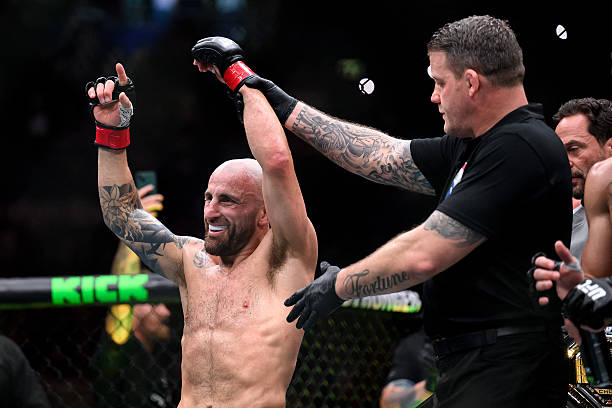
Alexander Volkanovski vs. Diego Lopes – The Champion’s Composure in a Razor-Close War
RESULT: Alexander Volkanovski vs. Diego Lopes via unanimous decision (49-46, 49-46, 50-45)
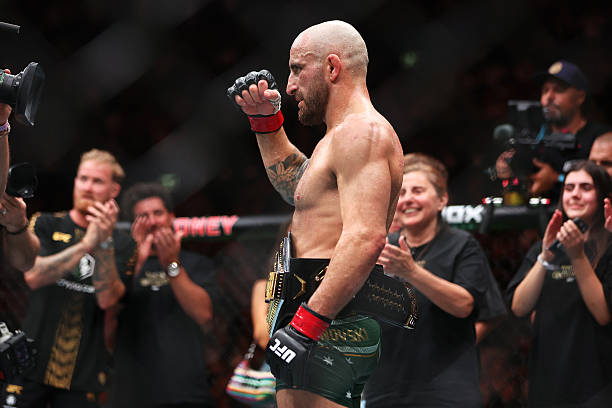
If this was supposed to be a potential swan song for Alexander Volkanovski, he certainly didn’t fight like a man ready to walk away.
Instead, the longtime featherweight king delivered a composed, veteran performance, one built on movement, discipline and championship poise, to edge out a dangerous, hungry challenger in Diego Lopes.
From the opening bell, the fight felt tense.
Both men stayed measured, trading low kicks and feints while probing for reads. Lopes brought early aggression, hammering Volkanovski’s lead leg and firing sharp counters whenever the champion tried to close the distance. Volkanovski answered with his usual footwork and jab, circling constantly and refusing to be trapped.
Nothing came easy.
Every exchange was competitive. Every round felt thin.
Volkanovski mixed in level changes and clinch work to keep Lopes guessing, while Lopes showcased slick takedown defence and quick hands in the pocket. The Brazilian’s speed was a real factor early, even briefly threatening submissions — jumping onto Volkanovski’s back in Round 2 and later snatching opportunistic guillotine looks.
But the difference was subtle and familiar: control.
Volkanovski dictated where the fight took place.
He managed distance better, landed the slightly cleaner combinations, and stayed just a half-step ahead in most striking exchanges. A stiff counter right in Round 3 visibly rocked Lopes and marked the clearest moment of damage either man produced. Lopes fired back later in the round with a flash knockdown of his own, but Volkanovski recovered instantly and never allowed momentum to snowball.
That moment summed up the fight: close, chaotic, but never quite slipping from the champion’s grasp.
The championship rounds leaned further toward Volkanovski’s experience. His jab piled up numbers. His footwork forced resets. And when Lopes tried to create scrambles late, Volkanovski calmly disengaged or reversed position, even finishing the fight on top after shutting down a last-ditch submission attempt.
No panic. No overreactions. Just composure.
After five tactical, back-and-forth rounds, the scorecards reflected that edge in consistency: unanimous decision for Volkanovski.
It was simply another mature performance from one of the smartest fighters of all time.
Lopes proved he belongs with the elite, though. His speed, scrambling and pressure made this one of the tighter fights of Volkanovski’s reign and showed he’s a genuine threat to anyone in the division.
But championship experience still counts for something. Volkanovski didn’t chase moments. He accumulated them, and over 25 minutes, those small wins added up.
The king isn’t done just yet.
Dan Hooker vs Benoît Saint Denis – Relentless Pressure and a Costly Gamble
RESULT: Benoit Saint Denis def. Dan Hooker via TKO (strikes) at 4:45 of R2
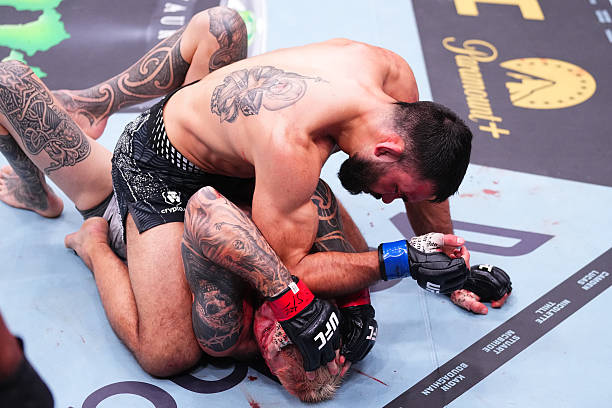
The co-main event promised violence on paper and, for one round at least, delivered a gruelling, attritional battle defined by pressure, defence and one pivotal mistake.
Dan Hooker began sharply.
Working behind his jab and a steady diet of kicks, he established range early and forced Benoît Saint Denis to shoot from too far out. The Frenchman’s initial takedown attempts were laboured and predictable, and Hooker punished each one, threatening a guillotine, escaping along the fence and repeatedly stabbing the body with heavy kicks that visibly slowed Saint Denis.
For stretches, it looked like a textbook anti-wrestling performance.
Hooker’s defensive awareness and cage work consistently denied clean entries, and every reset seemed to favour him. Combinations upstairs, kicks to the midsection, and sharp counters were steadily accumulating damage while Saint Denis burned energy chasing grips.
But Saint Denis thrives on persistence rather than efficiency.
Eventually, one attempt stuck.
A successful throw landed him in side control, and from there the tone shifted entirely. Short elbows began to pile up, followed by methodical positional advances. Even when Hooker scrambled back to his feet or found space, Saint Denis simply reset and drove forward again, forcing the fight back into grappling exchanges.
Then came the decisive moment.
In an ill-judged bid to reverse momentum, Hooker attempted a trip of his own. Instead of creating separation, he conceded position and found himself underneath Saint Denis in full mount — the worst possible place to be against a fighter built around suffocating top pressure.
From there, the damage mounted quickly.
Heavy elbows split Hooker open. An arm-triangle choke forced him to the brink, his face discolouring as Saint Denis tightened the squeeze. Hooker’s toughness kept him alive, but survival was all it was. When the choke slipped, the ground-and-pound resumed with even greater urgency.
Elbows, punches and positional dominance left little doubt.
As Saint Denis continued to rain down strikes with Hooker offering minimal defence, the referee stepped in to halt the contest.
This was a classic example of margins at the elite level.
Hooker did much of the early work correctly: defending takedowns, controlling range and landing the cleaner strikes. Yet against a pressure fighter like Saint Denis, one poor decision is often enough. The failed trip handed over everything he had fought to maintain.
For Saint Denis, the performance reinforces his identity as one of the division’s most exhausting puzzles. Even inefficient wrestling becomes effective when backed by relentless commitment and punishing top control. Few lightweights can sustain that kind of pace without breaking.
The result pushes him firmly toward the upper tier of the division once more.
For Hooker, it is a harsher lesson: one costly mistake will cost you in these big moments. And this one proved decisive. It’ll be interesting to see what his future holds
Rafael Fiziev vs Mauricio Ruffy – Precision Striking and a Breakthrough Finish
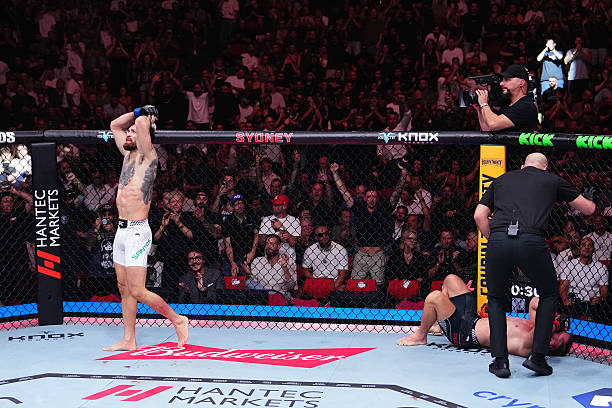
RESULT: Mauricio Ruffy def. Rafael Fiziev via TKO (strikes) at 4:30 of R2
After two grinding, scrappy contests to open the card, Rafael Fiziev and Mauricio Ruffy delivered something entirely different: a measured, high-level striking affair defined by patience, distance management and small tactical advantages.
For much of the opening round, neither man was willing to overextend.
They traded low kicks and feints, each probing for reactions rather than committing fully. Fiziev produced the flashier moments early, faking a level change before whipping a sharp overhand left over the top, then digging a heavy hook to the body that briefly stalled Ruffy’s movement. It was classic Fiziev: layered offence designed to disguise power shots.
Yet Ruffy’s response was composed rather than reckless.
Instead of chasing exchanges, he settled into a rhythm. A straight left found the chin, followed by sharp jabs and compact hooks that consistently beat Fiziev to the punch. While Fiziev offered bursts, Ruffy offered consistency. By the latter half of the round, it was Ruffy who appeared to be dictating tempo, landing the cleaner, simpler work as Fiziev struggled to establish flow.
The second round removed any ambiguity.
Ruffy opened with variety, a spinning back kick to the body, steady footwork and a persistent jab that began to mark up Fiziev’s face. Fiziev continued chopping at the legs, but his output lagged behind. Each time he paused, Ruffy filled the space with straight shots.
Gradually, the momentum tilted.
Then came the decisive moment.
A lunging right hand landed flush, immediately buckling Fiziev and stripping away his balance. Sensing the opening, Ruffy didn’t hesitate. He swarmed with controlled aggression, pouring on punches as Fiziev tried desperately to recover. There was no wildness to it. He’s just direct with clinical finishing instinct.
Fiziev stumbled, collapsed to the canvas, and the follow-up shots left the referee with little choice.
This was not merely an upset; it was an arrival.
Outstriking and then stopping a technician of Fiziev’s calibre signals that Ruffy is more than an exciting prospect. He showed composure in a slow fight, discipline in range and, most importantly, the ability to close when opportunity presented itself. Those are contender traits, not hopeful ones.
For Fiziev, the loss highlights a familiar problem at lightweight: moments of brilliance cannot compensate for stretches of inconsistency. Against opponents willing to match skill with volume, falling behind even slightly can prove fatal, and this was the first time he’s been duly punished.
For Ruffy, however, the message is clear.
He does not simply belong in this division — he is ready to disrupt it. Great comeback win.
Tai Tuivasa vs Tallison Teixeira – Missed Chances and Fading Margins
Tallison Teixeira def. Tai Tuivasa via unanimous decision (29-28, 29-28, 29-28)
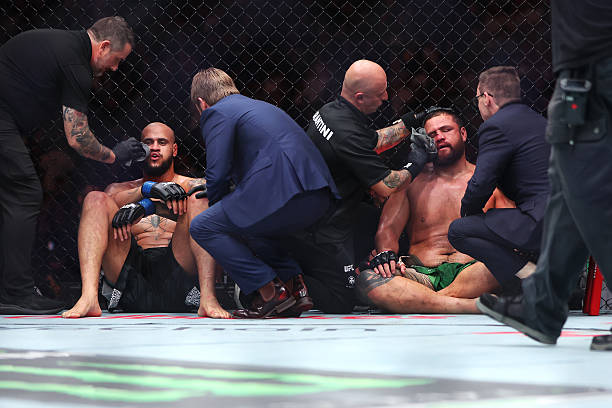
If this bout was intended to clarify Tai Tuivasa’s standing in the heavyweight division, it instead exposed the uncomfortable uncertainty surrounding his trajectory.
From the opening seconds, Tuivasa approached the fight with urgency, marching forward in search of a firefight. Yet that aggression quickly worked against him. Tallison Teixeira, far more composed than expected, changed levels almost immediately and grounded Tuivasa with relative ease.
It set the tone for much of the contest.
Teixeira’s grappling control proved problematic early. He repeatedly planted Tuivasa on the mat, advanced position and worked methodically through half guard to mount and back control. Tuivasa’s defence relied more on toughness than structure, absorbing punches while scrambling desperately for wrist control before eventually exploding back to his feet. The crowd’s frustration was palpable as long clinch stalls replaced meaningful offence.
The second round followed a similar pattern, albeit with sharper swings in momentum.
Tuivasa finally began to find success with his low kicks, targeting Teixeira’s base and forcing him backwards towards the fence. For the first time, the Australian looked comfortable dictating terms, mixing short flurries with elbows in close. When Teixeira tired, Tuivasa had his opening, a series of punches visibly wobbled the Brazilian and left him vulnerable.
It was the moment the fight seemed ready to turn.
Yet rather than press the advantage, Tuivasa clinched.
The decision allowed Teixeira valuable recovery time and ultimately squandered what was likely his best chance to secure a finish. From there, the bout descended into laboured grappling exchanges and sloppy scrambles, both men visibly fatigued. Teixeira returned to takedowns and positional control, while Tuivasa struggled to sustain offence.
By the end of the round, what could have been a defining comeback instead felt like an opportunity missed.
Heavyweight fights are often decided by singular moments, and Tuivasa had one, then let it slip.
While his durability and leg-kick offence showed flashes of life, the inability to capitalise when Teixeira was hurt raises familiar concerns about decision-making and conditioning. Against the best in the world, those windows simply do not reopen.
For Teixeira, the performance was messy but instructive. His willingness to wrestle and control position demonstrated a path forward that does not rely solely on striking exchanges, a necessary evolution at heavyweight.
For Tuivasa, however, the questions persist. At this stage of his career, moral victories and near-finishes carry little weight. This is now six losses in a row. It could spell the end of the UFC road.
Quillan Salkilld vs Jamie Mullarkey – Swift Statement Victory
RESULT: Quillan Salkilld def. Jamie Mullarkey via submission (rear-naked choke) at 3:02 of R1
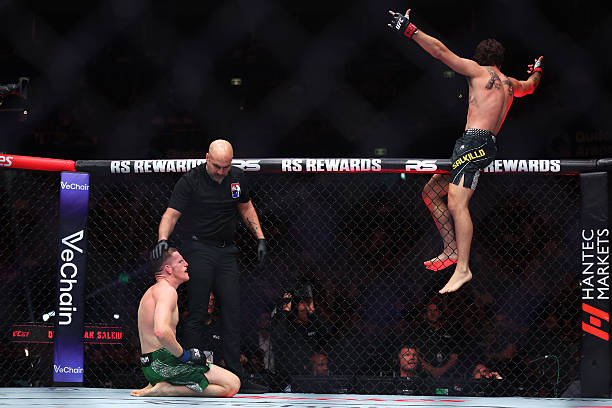
UFC 325’s main card opened with a clear narrative: momentum versus durability. What followed was less a drawn-out contest and more a decisive announcement.
Jamie Mullarkey began with his typical directness, opening with leg kicks and immediate forward pressure. Salkilld responded by changing levels early, shooting for a double-leg to establish grappling credibility and prevent Mullarkey from settling into rhythm. The initial scramble favoured Mullarkey, who reversed position and briefly secured a takedown of his own against the fence.
It was a promising start for the veteran, but it would prove fleeting.
Once back on the feet, Salkilld’s composure showed. A sharp left hand and low kick reset the distance before another clinch exchange along the cage. This time, Salkilld flipped the script entirely, reversing position, muscling Mullarkey to the canvas and immediately capitalising on the transition.
Rather than consolidating slowly, he moved with intent.
Salkilld took the back in one fluid sequence, threaded the hooks and locked in the rear-naked choke with clinical efficiency. There was no wasted motion, no frantic adjustment, just tight mechanics and immediate pressure. Mullarkey had little choice but to tap.
This wasn’t merely a win; it was a statement.
Submitting a seasoned, notoriously tough opponent like Mullarkey inside a round signals that Salkilld’s rise is not built on favourable matchmaking or narrow decisions. It demonstrated composure under pressure, opportunistic grappling and the kind of finishing instinct that fast-tracks prospects into meaningful fights.
In a lightweight division crowded with talent, efficiency matters. Salkilld didn’t just win, he removed doubt.
If this performance is any indication, he may not be far from facing names considerably higher up the ladder.
 TheWrestlingFallacy
Leave a comment