Justin Gaethje def. Paddy Pimblett via Unanimous Decision
(48-47, 49-46, 49-46)
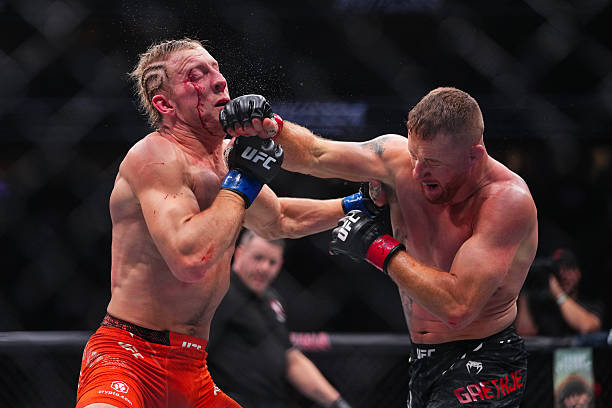
Justin Gaethje survived a spirited, at-times chaotic challenge from Paddy Pimblett to claim a hard-earned unanimous decision in a brutal Interim Lightweight Championship fight.
The opening round immediately set the tone. Pimblett came out assertive, investing in leg kicks and finding early success with an overhand right and head kick. Gaethje, however, needed only one clean opening to remind everyone of his danger. A thudding uppercut dropped Pimblett and triggered a ferocious swarm. Gaethje briefly threatened the neck but chose to force Pimblett back to his feet, where both men continued trading heavy leather. Pimblett showed impressive durability, landing elbows and kicks late to ensure the round remained competitive despite the knockdown.
Round two was Gaethje at his most punishing. Applying relentless pressure, he walked Pimblett down with jabs, hooks and crushing combinations against the fence. Repeated front headlock drags disrupted Pimblett’s rhythm, and a clean one-two sent Pimblett crashing to the canvas late in the round. Gaethje’s ground-and-pound and slicing elbows closed the frame with emphatic authority, marking the clearest round of the fight.
To Pimblett’s credit, he refused to fade. The third round saw him rally behind an increasingly effective jab, mixing body work with leg kicks and briefly wobbling Gaethje with a sharp double jab and uppercut. A flying knee to the groin halted momentum momentarily, but Pimblett resumed strongly after the restart, landing clean body kicks and forcing Gaethje into exchanges. For the first time, the pace appeared to trouble the veteran.
Gaethje responded in round four with composure and violence in equal measure. He absorbed jabs but answered with heavier artillery, rocking Pimblett repeatedly and battering him against the cage with flurries of hooks and uppercuts. Pimblett’s face showed the accumulation of damage, yet he continued to fire back, refusing to yield despite being consistently beaten to the harder shots.
The fifth round became a war of attrition. Pimblett pushed forward behind his jab and late blitzes, hunting a momentum-shifting moment, but Gaethje’s experience shone through. He defended takedown attempts, controlled clinch exchanges and continued to land the more damaging punches in close quarters. Even as exhaustion set in, Gaethje maintained pressure, finishing the fight on the front foot.
When the final horn sounded, both men were battered, but the outcome was clear. Gaethje’s knockdowns, sustained damage and control across five rounds earned him the decision and the interim title for a second time in his UFC career.
This was a defining fight for both men. For Gaethje, it reaffirmed his status as one of the sport’s most durable and dangerous competitors, capable of enduring chaos while imposing it on others, and he will go on to face Ilia Topuria at some point in the summer for the undisputed lightweight title. For Pimblett, despite the loss, this was a legitimising performance, like him or loathe him, tonight was proof that his toughness, confidence and willingness to engage hold up under elite fire. He may not have left with the win, but he left with credibility.
Sean O’Malley def. Song Yadong via Unanimous Decision
(29–28, 29–28, 29–28)
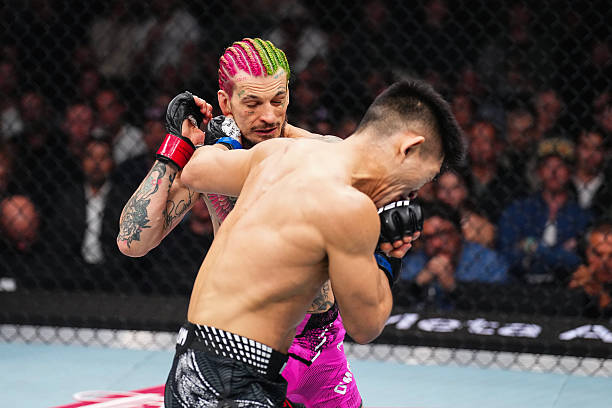
Sean O’Malley edged a tense, tactical contest against Song Yadong, leaning on precision, timing and late momentum to secure a unanimous decision in one of the card’s most strategically layered fights.
The opening round was defined by restraint. O’Malley worked behind body kicks, teeps and straight punches, while Song immediately committed to a heavy leg-kick attack, repeatedly targeting O’Malley’s lead leg. Neither man overextended, but Song’s willingness to mix in takedown threats paid dividends late in the round. A well-timed double leg brought the fight to the canvas, allowing Song to close the frame on top and steal a narrow advantage.
Round two tilted further towards Song’s approach. A thudding leg kick off the opening bell visibly disrupted O’Malley’s balance, forcing him to rely more heavily on teeps to create space. Song’s pressure became more physical, pinning O’Malley against the cage with a waist lock, mixing knees to the leg and foot stomps before completing another takedown. Although O’Malley remained active off his back and briefly threatened an omoplata, Song’s top control and damage edged the round in his favour.
The fight turned in the third.
O’Malley adjusted by increasing his urgency without sacrificing accuracy. While Song continued to invest in leg kicks and forward pressure, O’Malley began to find his timing. Clean left straights cut through Song’s guard, and a sharp knee up the middle visibly staggered him late in the round. Bloodied and slowing, Song absorbed multiple clean punches as O’Malley finished strongly, punctuating the final minute with his most effective sequence of the fight.
The judges returned identical 29–28 scorecards for O’Malley, reflecting a bout that hinged on adjustments rather than dominance.
This was a mature performance from O’Malley. He did not overwhelm Song with volume, but he made his moments count, showing composure under pressure and the ability to shift gears when the fight demanded it. For Song, the loss will sting. His leg-kick-centric game plan was effective for long stretches, but his inability to capitalise fully before O’Malley’s late surge proved costly.
O’Malley will probably look forward to a rematch with Petr Yan for the bantamweight title if he can best Merab Dvalishvili in their inevitable title fight rematch.
Waldo Cortes-Acosta def. Derrick Lewis via TKO (Round 2)
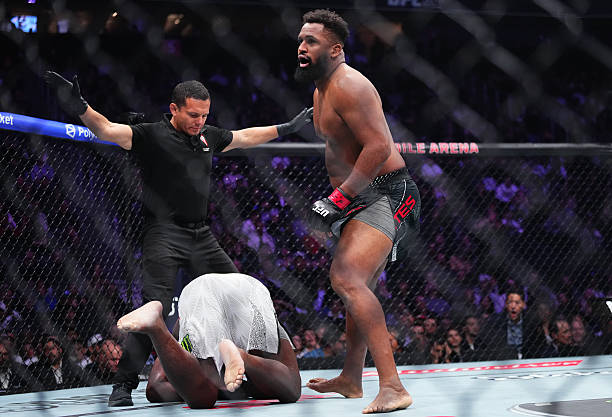
Waldo Cortes-Acosta produced a disciplined, unspectacular but ultimately decisive performance to stop Derrick Lewis in the second round, exposing the widening gap between technical consistency and fading explosiveness in the heavyweight division.
The opening round set the tone and not in a flattering way for Lewis. While the former title challenger flashed the occasional high kick, most were blocked or thrown without setup. Cortes-Acosta, by contrast, stayed true to a simple but effective game plan. He worked behind a steady jab, targeted the body early and chipped away at Lewis’ legs, refusing to be drawn into reckless exchanges.
Lewis’ lack of urgency was particularly telling. He lunged with wide hooks that consistently fell short, leaving himself open to straight counters. Cortes-Acosta’s jab repeatedly found its mark, snapping Lewis’ head back and halting any forward momentum before it could develop. A brief takedown after catching a body kick further underlined Cortes-Acosta’s control, even if little damage followed.
Round two brought increased desperation from Lewis, but not increased effectiveness. He rushed forward more aggressively, yet continued to walk onto clean jabs and straight rights. Cortes-Acosta’s timing was sharp, his shot selection conservative and correct. While Lewis did land a couple of meaningful punches, including a left hook and a right hand, they came in isolation, without follow-up or sustained pressure.
The end came in ignominious fashion. After slipping while avoiding a counter, Lewis chose to remain on the canvas, effectively conceding position. Cortes-Acosta wasted no time, stepping into top control and unloading with ground-and-pound until the referee intervened.
This was not a thrilling heavyweight contest, but it was an instructive one. Cortes-Acosta showed his patience, structure and basic fundamentals, but this is a fight that can’t be used to show if he’s ready for the likes of Tom Aspinall and Ciryl Gane at the summit of the division. For Lewis, the performance raised uncomfortable questions, mainly hinting that this should be the end of his career. It almost felt as if he was simply there for the paycheque, and clearly, after a minute of the fight realised he had barely a chance to beat Cortes-Acosta. It gets tougher to watch an icon of the sport fade away like this, but this should be the end of Derrick Lewis’ UFC career at the top level at the very least.
Natalia Silva def. Rose Namajunas via Unanimous Decision
(29–28, 29–28, 29–28)
Natalia Silva delivered the most complete performance of her UFC career, outmanoeuvring and outworking former champion Rose Namajunas over three tightly contested rounds to stake a serious claim in the flyweight division.
From the opening exchanges, Silva’s game plan was clear. Her constant hip feints and lateral movement kept Namajunas at range, denying her the clean entries and timing traps that have defined her best performances. Silva mixed low kicks with straight right hands, forcing Namajunas to reset repeatedly rather than establish any sustained rhythm.
Round one was a measured striking battle. Namajunas found success with jabs and outside leg kicks, but Silva consistently answered with cleaner, more varied offence. Oblique-style push kicks disrupted Namajunas’ stance, while a partially landed head kick late in the round underlined Silva’s comfort operating at range. A late takedown attempt from Namajunas was well defended, allowing Silva to close the round on the front foot.
The second round saw Namajunas increase her urgency. Early straight punches and a willingness to engage in the pocket gave her moments of control, particularly when she secured a takedown and worked from top position. Silva, however, remained composed on the bottom. While she flirted briefly with an armbar setup, her real success came through positional awareness, controlling wrists, using the fence to adjust angles and limiting Namajunas’ ability to inflict damage. It was a competitive round, defined by brief swings rather than dominance.
Silva decisively separated herself in the third. Increasing both pace and variety, she punished Namajunas with inside leg kicks, sharp jabs and repeated spinning back kicks to the body. As Namajunas’ entries slowed, Silva’s confidence grew. A clean side kick to the face and a well-timed hip toss into top position capped a round in which Silva consistently dictated where and how the fight took place. Even when briefly swept in the closing seconds, Silva finished the bout landing the final meaningful strike.
The judges returned identical 29–28 scorecards, reflecting a fight that was close but clearly favoured Silva’s consistency and control.
This is a big win for Natalia Silva. Beating a former champion through movement, composure and tactical discipline marks her as more than a rising talent, it positions her as a legitimate contender in a flyweight division and probably next in line for a title shot against Valentina Shevchenko.
Jean Silva def. Arnold Allen via Unanimous Decision
(30–27, 29–28, 29–28)
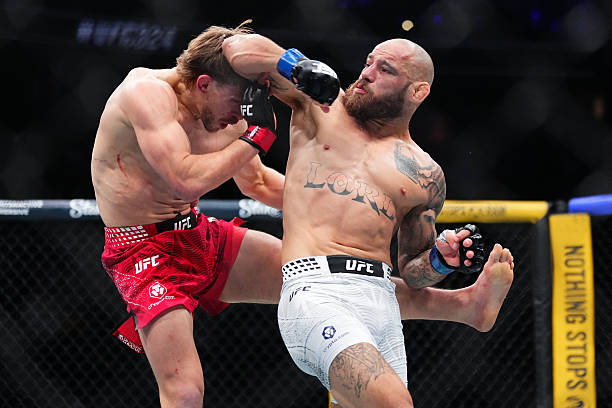
Jean Silva announced himself as a genuine force at featherweight with a high-intensity, momentum-driven victory over Arnold Allen, overturning early adversity to secure the biggest win of his career.
The opening round appeared to follow a familiar Arnold Allen blueprint. Calm and economical, Allen established his jab early and invested heavily in Silva’s lead leg, repeatedly finding the target with straight punches down the centre. Silva landed in bursts, particularly to the body, but his output was inconsistent, allowing Allen to build a clear lead through accuracy and control. Late drama briefly shifted the tone as Silva poured on heavy shots in the closing seconds, but the damage came too late to steal the round.
Round two marked a decisive change in rhythm. Silva emerged with greater urgency, committing to inside leg kicks and closing distance more aggressively. A brief takedown and a head kick signalled his intent, and from there the fight became far more chaotic. Allen had moments of success, particularly with counters and teeps to regain space, but Silva’s pressure began to tell. Spinning back elbows, overhand rights and sustained forward movement forced Allen onto the back foot, turning the round into a contest of durability rather than precision.
By the third, Silva was fully in control of the tempo. He mixed sharp uppercuts with body work, repeatedly breaking Allen’s posture and denying him the space needed to reset. Clinch exchanges favoured Silva, who used elbows and brief takedowns to maintain dominance without overcommitting. Allen attempted to disrupt the momentum with kicks and short grappling sequences, but Silva’s willingness to engage and his relentless pace kept him on the defensive.
As the final minutes ticked away, Silva embraced the chaos, gesturing for exchanges and continuing to land around Allen’s guard. Even an unconventional late scramble did nothing to dull his momentum, and the judges were left with little doubt when the scorecards were read.
This was a defining performance for Jean Silva. Beating a composed, high-level operator like Arnold Allen required not just aggression, but adaptability and Silva showed both. For Allen, the loss underscores the fine margins at the elite level, where it’s clear he doesn’t have the power to compete at the pinnacle of the sport. For Silva, however, this victory represents a step forward after his loss to Diego Lopes. Can he compete at the top level against featherweight’s elite? That is yet to be seen.
Prelims
Umar Nurmagomedov def. Deiveson Figueiredo via Unanimous Decision
(30–27) x3
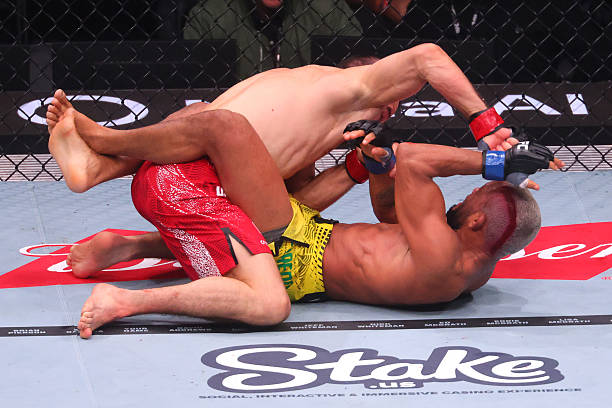
Umar Nurmagomedov delivered a composed, authoritative performance against former champion Deiveson Figueiredo, earning a clear-cut unanimous decision and reinforcing his status as one of the most structurally sound contenders in the bantamweight division.
From the opening round, Nurmagomedov established his preferred rhythm. Patient and measured, he used outside leg kicks and well-placed teep kicks to manage distance and deny Figueiredo the pocket exchanges where he thrives. While Figueiredo found moments of success — particularly with sharp counters and a well-timed uppercut–overhand combination in the clinch — Nurmagomedov consistently answered with control rather than chaos.
The first takedown told an important story. Nurmagomedov’s single-leg entry forced Figueiredo into a reactive grappling exchange, where the former champion was compelled to attack a guillotine simply to regain his feet. That pattern would repeat throughout the fight: Figueiredo surviving moments, Nurmagomedov dictating them. Once Nurmagomedov secured top position later in the round, his ground-and-pound was deliberate and effective, closing the frame firmly in his favour.
Round two briefly threatened to swing. Figueiredo showed improved urgency, even scoring a short-lived reversal early, but Nurmagomedov’s composure never wavered. Back on the feet, his kicking game resumed its role as both offence and defence, keeping Figueiredo at the end of his strikes. When exchanges did open up, Nurmagomedov’s cleaner right hands repeatedly found their mark, halting Figueiredo’s attempts to build momentum.
By the third round, the fight had settled into a familiar pattern. Nurmagomedov used his kicks to corral Figueiredo before shooting decisively, dragging him to the mat and establishing prolonged top control. From full guard into side control and back again, Nurmagomedov methodically wore down his opponent, landing punches while giving Figueiredo little opportunity to escape or threaten submissions. Figueiredo’s late attempts to create space were met with calm positional awareness, and the final horn sounded with Nurmagomedov firmly in command.
The scorecards reflected what had unfolded: three rounds to none.
This was not a flashy performance, but it was a telling one. Against a seasoned former champion, Nurmagomedov showcased maturity, tactical discipline and an ability to neutralise danger without overextending. In a division crowded with explosiveness and urgency, this kind of controlled dominance stands out — and moves Nurmagomedov another step closer to the very top of the bantamweight picture.
Middleweight: Ateba Gautier def. Andrey Pulyaev via unanimous decision (30-27, 29-28, 29-28)
Light heavyweight: Nikita Krylov def. Modestas Bukauskas via knockout (punches) at 4:57 of R3
Flyweight: Alex Perez def. Charles Johnson via TKO (punches) at 3:16 of R1
Early prelims
Heavyweight: Josh Hokit def. Denzel Freeman via TKO (retirement) at 4:59 of R1
Welterweight: Ty Miller def. Adam Fugitt via TKO (punches) at 4:59 of R1
 TheWrestlingFallacy
Leave a comment