
Part 1: Roots in Dagestan, Dreams Beyond
Khabib Nurmagomedov’s story begins not under the bright lights of Las Vegas, but in the rugged mountains of Dagestan, Russia. The region has long been a crucible for wrestlers, a land where combat sports are woven into the fabric of life. For Khabib, born in 1988, fighting was never a choice — it was a heritage.
His father, Abdulmanap Nurmagomedov, was not just a coach but a visionary. A veteran of the Soviet army and a judo and sambo master, Abdulmanap built makeshift gyms out of barns and community halls, molding young men into champions with nothing but grit, mats, and discipline. He instilled in Khabib not only technique, but values: humility, respect, faith, and an unyielding work ethic.
One image has followed Khabib for his entire career: as a boy, wrestling a bear cub on camera. It became a viral curiosity years later, but at its core it symbolised Abdulmanap’s belief — train harder than anyone else, fight without fear, and you will be unbreakable.
Part 2: The Sambo Base and Early Dominance
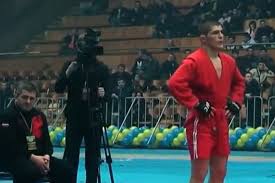
Before the UFC, Khabib was already a terror on the Eurasian circuit. He competed in Combat Sambo, winning multiple world championships. His style was defined early: relentless pressure, chain wrestling, and suffocating top control.
Between 2008 and 2011, he fought across Russia and Ukraine, racking up a perfect record of 16–0. He didn’t just win; he overwhelmed. By the time the UFC came calling in 2012, he was an unbeaten sambo world champion with a reputation for grinding opponents into exhaustion.
Part 3: Enter the Octagon (2012–2014)
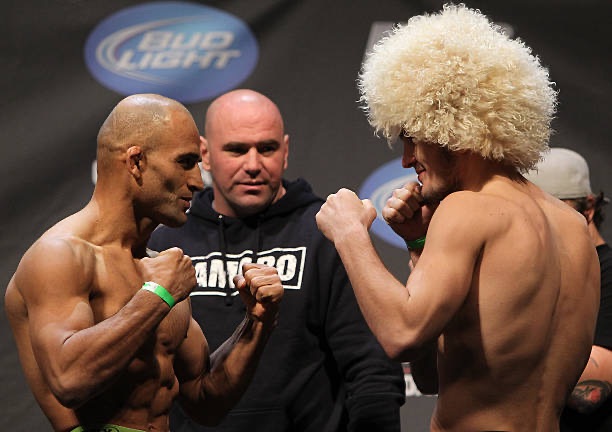
Khabib debuted in the UFC in January 2012 at UFC on FX 1, submitting Kamal Shalorus with a rear-naked choke in the third round. From there, he rattled off wins with a style that was equal parts thrilling and terrifying.
The breakthrough came against Abel Trujillo at UFC 160 (2013). Khabib set a UFC record with 21 takedowns in a single fight — a statistic that still stands today. Trujillo looked helpless, a man caught in a riptide he couldn’t escape.
He followed that with a dominant win over future champion Rafael dos Anjos in 2014, ragdolling the Brazilian with hip throws and clinch work. By then, it was clear: a new force had arrived in the lightweight division.
But then came the stall. Injuries, surgeries, and layoffs kept Khabib out for nearly two years. His momentum paused, his body tested. Many wondered if the promise would fade before it blossomed.
Part 4: The Return and the Road to Gold (2016–2018)

Khabib returned in 2016 with a vengeance. He demolished Darryl Horcher, then mauled Michael Johnson at UFC 205 (2016) in New York. The Johnson fight became legendary not just for the dominance, but for Khabib’s mid-fight dialogue:
While pinning Johnson to the mat and raining punches, Khabib leaned down and said:
“You must give up. I need to fight for the title. You know this.”
It was a chilling window into his mindset: cold, rational, inevitable.
A scheduled fight with Tony Ferguson fell through multiple times, but by 2018, the opportunity finally arrived. At UFC 223, Khabib defeated Al Iaquinta over five rounds to become the UFC lightweight champion. He had realised Abdulmanap’s dream.
The Eagle’s Flight: The Rise, Reign, and Retirement of Khabib Nurmagomedov
Part 2: The Reign and the Rivalries (2018–2019)
UFC 229 — McGregor, Mauling, and Mayhem (October 6, 2018)
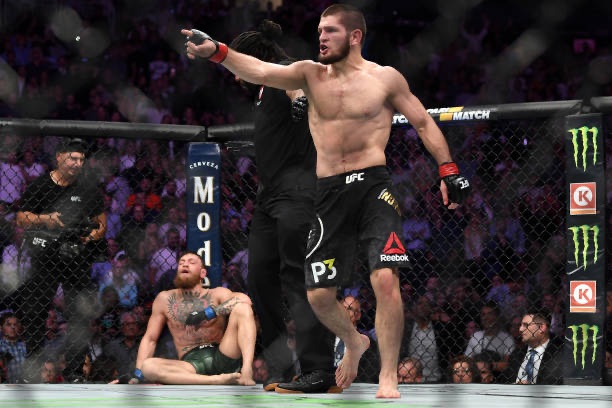
The week felt combustible from the start. Months after a Brooklyn bus window exploded beneath the weight of a steel dolly, months of insults about faith, family, and nation, Khabib walked first to the Octagon—stoic, unblinking, hood up, the sound of recitation and resolve around him. Across from him, Conor McGregor paced, chin high, a grin pulled tight over bare contempt.
Round 1. No mystery. Khabib shot early—level change to a long drive, welding McGregor to the fence. There, he began the craft that defined his era: head position under the chin, hands locked behind the knees, step-behind trip, and that suffocating Dagestani handcuff on the far wrist once they hit the floor. McGregor posted, wriggled, and stalled, but Khabib patiently stacked him, peeling limbs and pouring in knuckles from short range. Little damage, massive control. The point wasn’t pain. It was message: we do this my way.
Round 2. The surprise. Khabib feinted low and detonated an overhand right that cracked flush and sent McGregor stumbling backward. The wrestler had just won a puncher’s exchange. The crowd gasped; Khabib did not pursue recklessly—he returned to faith and habit: takedown, fence pin, ride. From half guard to mount to back exposure, he unspooled ground-and-pound in thudding clusters. McGregor’s arms softened, the mouth opened. When the horn finally came, the frame felt like a 10–8 without debate—dominance, danger, and a widening gulf.
Round 3. The only McGregor success. Back on the feet, he managed to stuff early entries and thread a few left hands and front kicks to the body. It wasn’t vintage venom—more a veteran’s stabilising round—but it slowed the bleeding. Khabib jabbed more than expected, kept his feet under him, and banked data for the close.
Round 4. Khabib returned to inevitability. Clinch. Trip. Mat. He laced the wrist again, climbed as McGregor tried to turn, and slid his forearm across the jawline. Not under the chin—didn’t need to be. A face crank, torque on the neck, crushing pressure through the hips. McGregor tapped at just past three minutes. No scream, no celebration—only Khabib, rising, pointing, speaking to the corner that had fed the animus all year.
And then the air snapped. Khabib vaulted the fence toward McGregor’s cornerman, a tangle of bodies tumbling into the first rows. In the cage, teammates clashed with McGregor. Security swarmed. It was the sport’s biggest night and ugliest scene at once—victory drowned out by a brawl that would bring fines, suspensions, and a months-long debate about lines crossed and exploited.
Strip away the noise, and the tape still says the same thing: Khabib didn’t just beat McGregor; he took away his choices. Where to stand, when to breathe, how to escape. A striker’s toolkit got locked in a wrestler’s vise—and the sport understood it was watching a champion at the height of his powers.
UFC 242 — Dustin Poirier and the Grace of Closure in Motion (September 7, 2019)
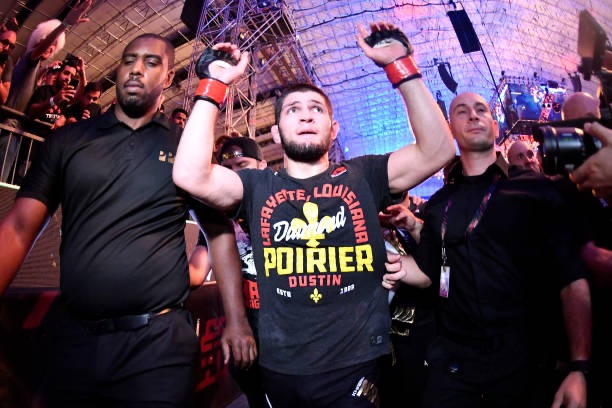
Eleven months later in Abu Dhabi, the tone was different—less venom, more reverence. Dustin Poirier arrived as interim champion, a craftsman with volume boxing, underrated grappling, and an unshakeable heart. Khabib arrived as the standard.
Round 1. Same compass. Khabib marched into range with a high guard, touched the hips, and corralled Poirier to the fence. From there: cross-wrist control, mat return, the slow drowning. Poirier hand-fought and tried to wedge knees inside; Khabib floated, pounded, and broke posture. The message was familiar—welcome to deep water.
Round 2. A jolt of drama. Poirier clipped Khabib with a right hand that sent him skittering along the fence. For a few heartbeats the arena leaned forward—was this how you stop the tide? Khabib circled, gathered himself, and went back to certainty. He level-changed, ran Poirier to the barrier, and resumed the ride: mat returns, wrist traps, short hooks. The scare passed; the pattern resumed.
Round 3. Poirier jumped a guillotine as Khabib shot—a last leverage play from a man who knows you sometimes have to gamble to change a story. It was tight for a blink; then Khabib shrugged, passed, took the back. The hooks sank like anchors. The forearm slid under the chin this time. Rear-naked choke. Tap.
What followed was the counterpoint to UFC 229’s chaos: Khabib embraced Poirier, asked the crowd to support his charity, swapped shirts—a champion’s ritual turned into a statement of values. In the moments after pure dominance, he chose respect.
Part 3: UFC 254 — Gaethje, the Promise, and the Perfect Exit
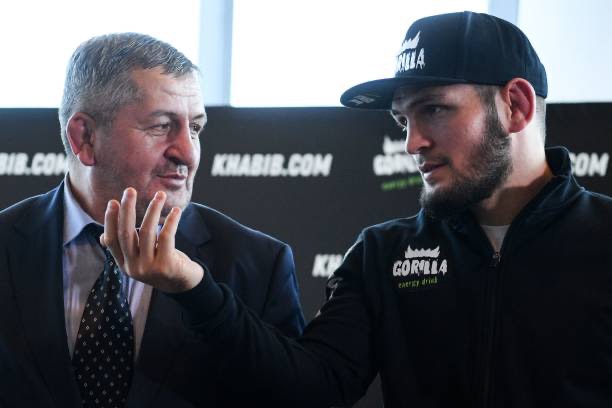
By 2020, Khabib was 28–0, the undisputed lightweight champion, and widely regarded as one of the most dominant forces MMA had ever seen. But this fight was different.
Earlier that year, his father and lifelong coach, Abdulmanap Nurmagomedov, had passed away due to complications from COVID-19. For Khabib, it was a loss deeper than sport — the man who had built his career, who had stood in his corner for every milestone, was gone. Before UFC 254, Khabib promised his mother he would fight once more, then retire.
The opponent was Justin Gaethje, a man known for chaos: violent leg kicks, knockout power, relentless pace. If anyone could force Khabib into a brawl, it was him. Yet the version of Khabib that night wasn’t emotional or reckless. It was the most complete version we ever saw.
UFC 254: Khabib vs. Gaethje (October 24, 2020)
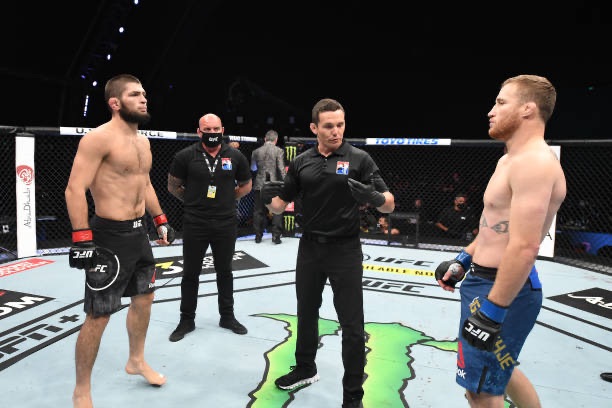
Round 1. Gaethje started with urgency, chopping at Khabib’s lead leg with brutal kicks and landing sharp counters. For a moment, it looked like the formula to slow the pressure. But Khabib never flinched. He marched forward, checked the range with his jab, and pressed Gaethje backward with suffocating pace. Midway through the round, Khabib shot and secured a takedown, sliding effortlessly into mount. He rained ground-and-pound as the horn saved Gaethje.
Round 2. Khabib stalked again, walking Gaethje down, refusing to give space. He caught a kick, transitioned seamlessly to the mat, and floated straight into mount. In one fluid motion, he trapped Gaethje’s arm and locked up a triangle choke from the top. It was beautiful, clinical, inevitable. Gaethje tapped, but the referee missed it for a beat; when he went unconscious, Khabib immediately released the hold and sat back.
3:34 of Round 2. Submission victory. 29–0. Perfection.
The Retirement
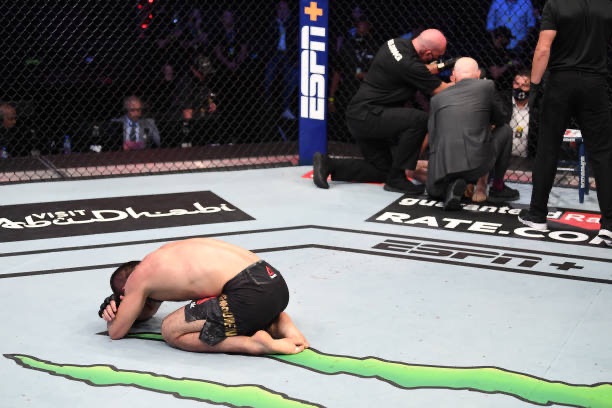
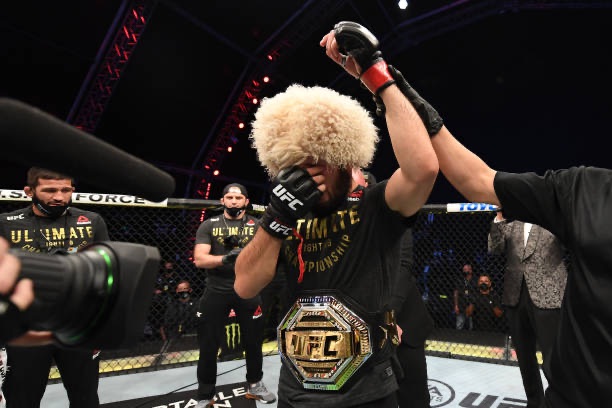
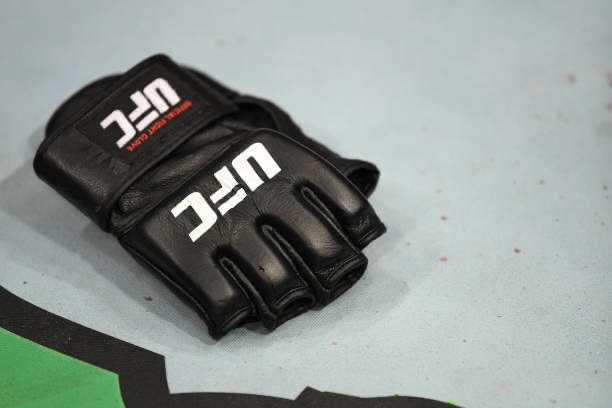
Khabib didn’t celebrate. He didn’t climb the cage or call out another opponent. Instead, he knelt in the centre of the Octagon, head buried in his hands, sobbing. The grief of fighting without his father, the weight of the promise to his mother, and the finality of a perfect career washed over him all at once.
Then he stood and took the microphone. His words were simple, humble, and final:
“Today I want to say, this was my last fight. No way am I going to come here without my father… I promised my mother this is going to be my last fight.”
There was no rematch, no drawn-out decline, no comeback. He walked away at the peak of his power, belt in hand, legacy untouched. In a sport where so few leave on their own terms, Khabib’s exit was as dominant and dignified as his fighting style.
Legacy of UFC 254
- He retired undefeated at 29–0, never once knocked down or submitted.
- He defended the lightweight title three times, each in commanding fashion.
- He honoured his father’s vision while keeping a promise to his mother, merging family, faith, and sport in a way few champions ever do.
Khabib’s last fight wasn’t just a victory — it was a statement. Not about being unbeatable, but about living by principles in a world where power and fame so often erode them.
Part 4: The Eagle’s Legacy, Five Years On
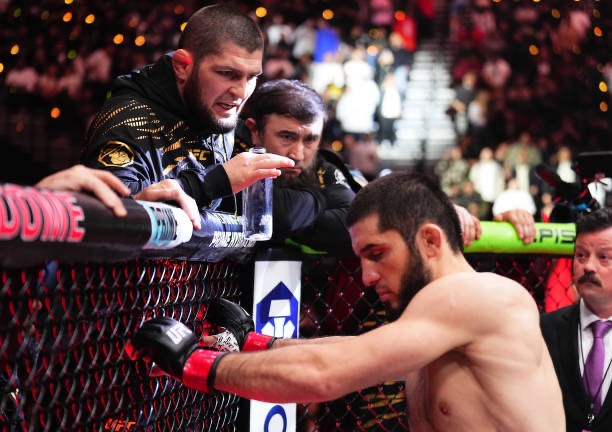
There are few exits in sports that feel like myth. Ali fought too long. Jordan came back twice. Even the greats in MMA usually linger until someone younger, sharper, hungrier ushers them out.
But Khabib Nurmagomedov was different.
Five years ago, on Fight Island, he bowed to the canvas after submitting Justin Gaethje and left the sport on his own terms. Undefeated. Untouched. Unmoved by the temptations of money or revenge. He promised his mother he would not fight again without his father, and he kept that promise. In a cage built on ego and spectacle, he chose something rarer: discipline and closure.
Khabib’s legacy isn’t just the record — though 29–0 stands as an unbreakable monument. It’s the way he won. He never needed a comeback knockout or a split decision. He never left doubt. He entered, imposed, and suffocated. Against McGregor, Poirier, Gaethje — each man came with fire, and each man was extinguished by the same methodical tide. His fights weren’t thrill rides; they were inevitabilities.
And yet, paradoxically, what made him beloved wasn’t the dominance but the humility wrapped around it. He prayed before and after battle. He honoured his father at every step. He swapped shirts with opponents, raised money for their charities, reminded the crowd there were bigger fights than the ones inside the Octagon.
For Khabib, the Octagon was never the destination. It was the vessel. The destination was respect.
Now, five years removed, the sport feels his absence. Lightweight has churned through champions and contenders. The belt has changed hands; rivalries have sparked and fizzled. But none have carried the same aura of inevitability. None have brought the same mix of fear and reverence.
The Eagle’s shadow lingers in every wrestler who chains takedowns against the fence, in every fighter who preaches values as loudly as violence, in every champion who wonders if they can walk away before the game takes more than it gives.
Khabib Nurmagomedov’s career was not the loudest, not the flashiest, not even the longest. But it was pure. And in a sport where purity is so rare, that may be why his legacy endures.
He taught us that dominance can be respectful. That greatness can coexist with humility. That you can rise from a village gym in Dagestan, conquer the cage, and still know when to leave.
Five years on, the memory of UFC 254 still feels like a paradox: the sadness of goodbye, the perfection of timing, the closure of a story told exactly as it was meant to be told.
The Eagle didn’t fall. He didn’t fade. He soared until he chose to land.
 TheWrestlingFallacy
Leave a comment